At Plunge Pools Adelaide, we help homeowners understand and follow this process from start to finish. Our team works with South Australian councils, certifiers, engineers, and trades to install plunge pools that are safe, legal, and built for Adelaide conditions. We do not just install pools; we guide people through approvals, soil checks, crane access, fencing rules, and final certification so there are no surprises later.
In this checklist, you will learn exactly what to check before installing a plunge pool in Adelaide. We will cover property suitability, local rules, real costs, soil and drainage, safety laws, installation steps, and long-term responsibilities. By the end, you will know whether your property is suitable, what must be approved first, and how to move forward with confidence and clarity.
Is Your Adelaide Property Suitable for a Plunge Pool?
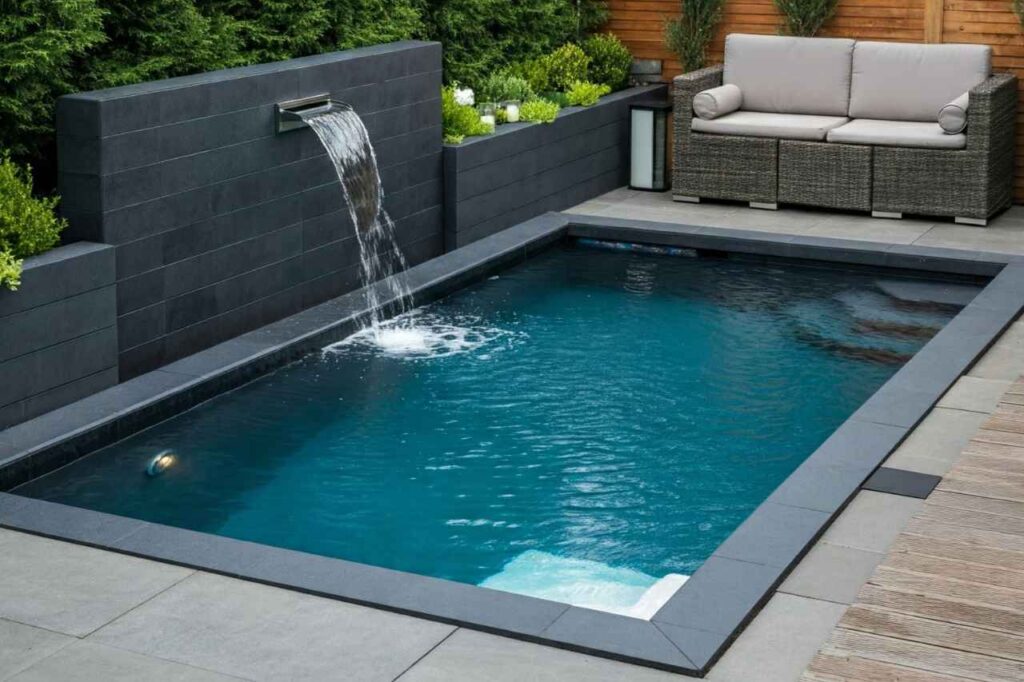
Your Adelaide property is suitable for a plunge pool only if the soil is engineered, council rules allow a pool, setbacks and easements are clear, and the ground can safely support the pool without movement or drainage issues.
Soil Test Comes First (Non-Negotiable in Adelaide)
Adelaide is well known for reactive clay soil, especially in suburbs across the Adelaide Plains and foothills. This type of soil expands when wet and shrinks when dry, causing ground movement throughout the year.
A soil test (geotechnical report) measures:
- How reactive your soil is
- Expected ground movement
- Bearing capacity of the site
- Drainage behaviour after rain
Engineers use this data to design:
- The correct pool base
- Reinforcement and footings
- Drainage systems to prevent uplift
If you skip a soil test, common long-term risks include:
- Pool shell tilting or sinking
- Cracks in concrete or coping
- Broken plumbing and leaks
Warranty disputes and insurance issues
Tip: Always get a soil report before signing any plunge pool contract. Reputable Adelaide pool installers will insist on this step.
Check Zoning, Easements, and Setbacks
Even with good soil, your property must meet South Australian planning rules.
You need to confirm:
- Zoning allows a swimming or plunge pool
- No easements or underground services where the pool is planned
- Boundary setbacks meet council requirements
- Distance from buildings and fences is compliant
Many Adelaide properties have drainage or sewer easements that legally block pool installation, even if space looks available.
Drainage and Site Levels Matter
Poor drainage is one of the biggest hidden risks for plunge pools in Adelaide.
Your site must:
- Drain water away from the pool shell
- Prevent groundwater build-up under the pool
- Handle heavy winter rain without soil softening
Without proper drainage, pools can lift, move, or crack, especially after storms.
Access for Installation
Most plunge pools are delivered by crane or truck.
Check early:
- Crane access to the backyard
- Overhead powerlines or trees
- Driveway width and turning space
Restricted access can add thousands of dollars in extra costs or rule out certain pool types.
Final Suitability Checklist
Your Adelaide property is suitable for a plunge pool if:
- A soil test confirms stable, engineerable ground
- Zoning and council rules allow a pool
- Easements and services are clear
- Setbacks and safety requirements can be met
- Drainage is properly designed
- Installation access is available
If even one of these fails, the project can stall or become far more expensive.
Adelaide’s Pool Approval Rules (What You Must Know)
In South Australia, every plunge pool requires Development Approval, regardless of size or type. This approval has two parts: Planning Consent, which checks location and setbacks, and Building Rules Consent, which checks structure, fencing, and safety. Without both, your plunge pool is not legal.
This includes two steps:
1. Planning Consent (Location & Land Use)
Planning Consent focuses on where the plunge pool sits on your property. This stage checks whether the pool is allowed in that location under your council’s planning rules.
Planning Consent typically assesses:
- Property zoning (residential compliance)
- Boundary setbacks
- Easements and underground services
- Heritage, flood, or bushfire overlays
- Impact on neighbouring properties
- Site access and layout
If your plunge pool is too close to a boundary, built over an easement, or placed in a restricted overlay area, planning consent can be refused or require design changes.
2. Building Rules Consent (Safety & Construction)
Building Rules Consent focuses on how the plunge pool is built and whether it is safe.
This stage checks compliance with:
- Structural engineering requirements
- Soil and footing conditions
- Pool shell installation method
- Plumbing and drainage
- Electrical safety
- Pool fencing and gate compliance
- AS 1926 Australian pool safety standards
- Mandatory CPR signage and barrier heights
Even a precast concrete plunge pool or above-ground plunge pool must meet these building and safety rules in Adelaide.
Who Approves a Plunge Pool in South Australia?
- Local council assesses and grants Planning Consent
- A private certifier or council can grant Building Rules Consent
Many homeowners use a private certifier for faster turnaround, but councils can handle both stages in some cases.
Your plunge pool is not legally recognised until:
- Planning Consent is approved
- Building Rules Consent is approved
- The approvals are formally recorded
- Final inspections and certification are completed
What It Really Costs to Install a Plunge Pool in Adelaide
The total cost to install a plunge pool in Adelaide is usually $45,000–$70,000+, not just the pool shell.
Most of the budget goes into excavation, soil management, crane hire, plumbing, electrical work, and safety fencing; many people forget to allow for this upfront.
| Pool Type | Typical Total Cost | Strength | Lifespan | Best For |
| Fibreglass | $45,000–$55,000 | Lighter, easy install | ~20 years | Flat, stable sites |
| Concrete (Precast) | $60,000–$70,000+ | Stronger, durable | 40+ years | Reactive or sloped sites |
Why Costs Rise
- Soil conditions: Reactive clay = deeper excavation and drainage.
- Crane reach: More distance = higher cost.
- Access: Narrow lanes or steep blocks need special gear.
Knowing full costs early helps you plan properly instead of rushing when bills grow later.
Which Pool Type Is Best for Adelaide Conditions?
Fibreglass pools suit flat, stable Adelaide blocks, while precast concrete pools are best for reactive clay soil, sloping sites, and Adelaide Hills properties.
Fibreglass Pools
- Quick to install
- Smooth surface, easy to clean
- Warms up fast but loses heat quickly
- Best for flat coastal or suburban sites
Precast Concrete Pools
- Heavy and solid — ideal for reactive clay
- Keeps water temperature steady
- Sloping or Adelaide Hills sites
- `Long lifespan and low movement risk
In short:
If your block is flat and stable, fibreglass works fine.
If you’re on clay or a hill, go concrete.
DIY vs Professional Installation (The Adelaide Risk Factor)
- DIY plunge pool installation may look cheaper upfront, but in South Australia, only licensed professionals can legally handle structural pool work, plumbing, and electrical connections.
If unlicensed work is discovered, your pool can fail inspections, void insurance, and be ordered to stop or removed.
DIY may look cheaper, but South Australian law says only licensed tradespeople can handle:
- Structural pool work
- Plumbing and electrical connections
If you do unlicensed work:
- You can’t get insurance or a warranty
- You risk failed inspections or stop orders
Professional installation gives you:
- Proper engineering
- Warranty protection
- Legal certification
At Plunge Pools Adelaide, we handle every approval and inspection — so you’re never left guessing what comes next.
Why Are Soil, Drainage & Base Engineering Non-Negotiable for Plunge Pools in Adelaide?
Because Adelaide has reactive clay soils that move with moisture, and without proper soil testing, drainage, and engineered foundations, plunge pools can lift, sink, crack, or fail — leading to costly repairs.
Why This Matters More in Adelaide
Everything about your plunge pool depends on what’s underneath it — and in Adelaide, the ground is rarely stable.
Many suburbs sit on reactive clay soil, which behaves like a sponge:
- When clay gets wet, it swells → pushing the pool shell upward
- When clay dries out, it shrinks → causing the pool to settle, tilt, or crack
This constant movement puts stress on the pool structure, plumbing, and surrounding paving. Without the right base design, even a high-quality plunge pool can fail.
That’s why soil, drainage, and base engineering are not optional extras — they’re structural necessities.
The 3 Must-Dos Before Digging in Adelaide
Before excavation starts, every plunge pool site should include:
- A soil test and engineering plan
Ensures the base is designed for your exact soil conditions, not averages. - A proper drainage layer
Usually, crushed rock and agricultural drainage are used to move water away from the pool. - Correct backfilling materials
Loose or reactive soil should never be reused around the pool shell.
These steps are standard for long-term structural stability — not upgrades.
The Cost of Getting It Wrong
Skipping soil testing, drainage, or engineering may save money upfront, but it often leads to:
- Cracked pool shells
- Uneven or sunken pools
- Broken plumbing lines
- Voided warranties
- Repairs exceeding $10,000 or more
In severe cases, pools may need partial or full removal.
Why Is Site Access & Crane Planning Critical for Plunge Pool Installation?
Site access and crane planning are critical because most plunge pools are delivered as a single heavy shell and must be craned into position. Poor access, misjudged crane reach, or overlooked obstacles can cause delays, extra costs, or even make installation impossible on the day.
What Must Be Planned Before You Dig
Proper crane and access planning should happen before excavation, not after the hole is already in the ground.
Key checks include:
- Crane booking early
Crane availability is limited, especially in peak seasons. Booking late can delay installation by weeks. - Reach and swing distance
The crane must safely reach from the street (or driveway) to the pool location, including vertical and horizontal clearance. - Overhead obstacles
Trees, power lines, roofs, antennas, and fencing all affect crane selection and lift method. - Ground conditions for the crane
Soft soil, slopes, or narrow streets may require a larger crane or engineered setup. - Council and street access rules
Some Adelaide councils require permits for crane setups on roads or footpaths.
Why Early Planning Saves Money (and Stress)
Poor crane planning is one of the most common causes of plunge pool installation delays.
When site access is assessed early, you can:
- Choose the correct pool size and orientation
- Lock in the right crane the first time
- Avoid excavation rework
- Prevent last-minute council or neighbour issues
In short, crane planning protects your timeline, your budget, and your sanity.
What Utilities & Services Lie Beneath Your Adelaide Property Before You Dig?
Before digging for a plunge pool in Adelaide, you must check underground utilities using BYDA (Before You Dig Australia). A BYDA search shows gas, water, sewer, electricity, and communications lines so you can avoid damage, delays, and legal liability.
What You Must Do Before Any Excavation
Before excavation begins, these steps are non-negotiable:
1. Submit a BYDA Search
- Lodge a Before You Dig Australia (BYDA) enquiry
- Results usually arrive within 48 hours
- Covers gas, water, sewer, electricity, NBN, and telecommunications
This is required before any plunge pool excavation in South Australia.
2. Review All Service Plans Carefully
BYDA maps show:
- Depth and location of underground services
- Service authority ownership
- “No-go” zones for excavation
Important: Plans are guides, not guarantees. On-site verification may still be required.
3. Adjust Pool Placement If Needed
If services run too close:
- The pool location may need shifting
- Engineering design may change
- Hand digging or potholing may be required
This can affect:
- Pool size
- Orientation
- Crane access
- Final installation cost
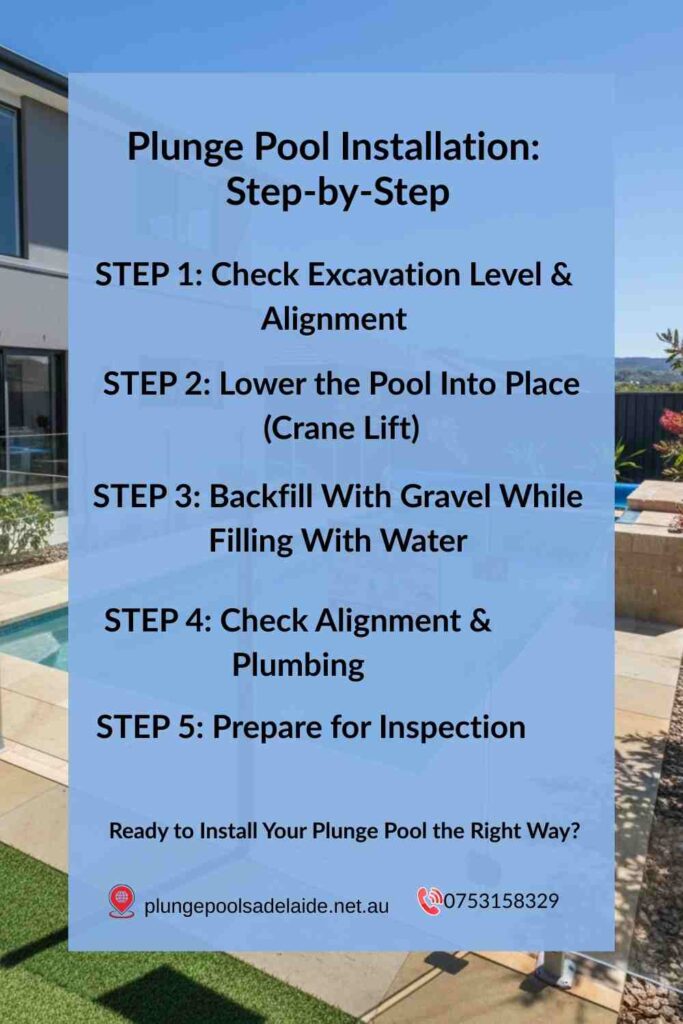
Safety Barriers & Fencing Rules (SA Law)
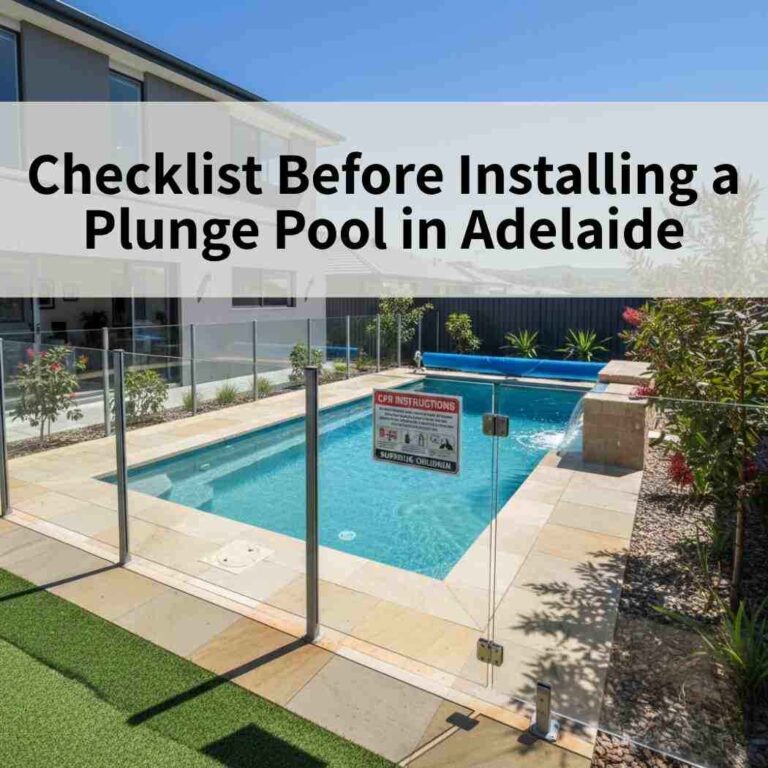
In South Australia, you must have a compliant pool safety barrier installed and approved before a pool is filled with water, even partially.
Temporary fencing must meet Australian Standards, gates must self-close and self-latch, and non-compliance can attract fines of up to $15,000.
These rules exist to prevent child drownings — and councils enforce them closely.
1. You Need a Safety Barrier Before Filling the Pool
Under South Australian regulations:
A compliant safety barrier must be installed and approved before the pool is filled, even with a small amount of water
This applies to:
- Precast concrete plunge pools
- Fibreglass pools
- Temporary or relocatable pools
- Filling a pool without an approved barrier is considered a serious offence
Important: Even water collected from rain can trigger non-compliance if no barrier is in place.
2. Temporary Pool Fencing Is Allowed — But Only If It Complies
During construction, most Adelaide pool installations use temporary pool fencing. However, temporary barriers must still comply with AS 1926.1 – Swimming Pool Safety.
Temporary fencing must include:
- Minimum height of 1.2 metres
- No climbable gaps or footholds
- Panels securely fixed to the ground
- A self-closing, self-latching gate
- Latch positioned at least 1.5 metres above ground or shielded
Temporary fencing must be inspected and approved by a council or private certifier before the pool is filled.
3. Pool Gates Must Self-Close and Self-Latch
All pool gates in South Australia — temporary or permanent — must:
- Swing away from the pool area
- Self-close from any open position
- Self-latch automatically
- Never be propped open or tied back
A gate that doesn’t self-close properly is one of the most common reasons pools fail inspection.
4. Permanent Pool Fencing Requirements
Once construction is complete, permanent pool fencing must also comply with AS 1926 and local council conditions.
Permanent fencing rules typically include:
- Minimum height of 1.2 m
- No gaps greater than 100 mm
- Non-climbable zone of 900 mm
- House walls and doors cannot usually form part of the barrier unless specifically approved
- No climbable objects (pots, chairs, BBQs) within the barrier zone
Once permanent fencing passes final inspection, the temporary fencing can be legally removed.
5. Fines and Penalties for Non-Compliance
Failure to comply with pool fencing laws in South Australia can result in:
- On-the-spot fines
- Maximum penalties of up to $15,000
- Stop-work notices
- Delays to final certification
- Insurance issues if an incident occurs
Councils take pool safety seriously, and inspections are not optional.
When Is a Plunge Pool Legally Complete in Adelaide? (Final Inspection & Certification)
Your plunge pool is only legally complete in Adelaide once a licensed building certifier carries out a final inspection and issues a completion certificate.
Until this happens, the pool is not legally approved to use — even if it’s filled, finished, and looks ready.
What the Certifier Checks
1. Pool Structure & Installation
- Pool shell matches approved engineering drawings
- Correct footing, base preparation, and drainage
- No visible movement, cracking, or structural defects
2. Pool Safety Barriers & Fencing (AS 1926)
- Compliant pool fencing installed around the pool
- Fence height, gaps, and climbable zones meet Australian Standards
- No objects within non-climbable zones
3. Gates, Latches & Access Points
- All gates are self-closing and self-latching
- Latches are installed at the correct height
- Gates swing away from the pool area
4. Mandatory Safety Signage
- CPR and resuscitation signage installed and visible
- Signage meets South Australian pool safety requirements
5. Clear Zones & Setbacks
- Required clearances around the pool are maintained
- No structures, furniture, or landscaping breaches safety zones
- When passed, they send a completion notice to the council, and your insurance and warranty take effect.
What Happens During the First Fill & Water Setup of a Plunge Pool?
During the first fill of a plunge pool, the filtration system is started, the water is chemically balanced, and all equipment is tested to ensure the pool is safe, clean, and ready to use. This process protects the pool surface, prevents damage, and sets the foundation for clear, healthy water.
What Happens:
- Water filters run to remove dust and residue
- pH, alkalinity, and chlorine are balanced
- The system is tested for leaks or noise
Balanced water protects the pool finish and keeps the water clear.
Ideal Start Levels:
- pH: 7.2–7.6
- Alkalinity: 80–120 ppm
How Can You Landscape Around a Plunge Pool Without Breaking the Rules?
You can landscape around a plunge pool in South Australia, but you must keep a 900mm non-climbable zone around the pool barrier clear of objects like pots, seating, retaining walls, deck edges, and plants. Adding obstacles after certification can make your pool fencing non-compliant and require reinspection or costly changes.
Keep a 900mm non-climbable zone around fences clear of:
- Plant pots or raised planters
- Retaining walls or garden edging
- Fixed or movable seating
- BBQs, benches, or storage boxes
- Decking steps or level changes
- Rocks, statues, or water features
Even decorative items count if they reduce the effective fence height or provide a foothold.
Landscaping around a plunge pool in Adelaide must be designed with pool fencing compliance in mind, not just aesthetics. Respect the 900mm non-climbable zone, plan ahead, and your pool will stay legal, safe, and stress-free long after installation.
What Ongoing Maintenance & Compliance Is Required After a Plunge Pool Is Installed?
After a plunge pool is installed, owners must carry out ongoing safety and maintenance checks. This includes monthly inspections of pool fences and gates, keeping the 900mm non-climbable zone clear, maintaining pumps and filters, and rechecking compliance between tenants for rental properties. Regular checks help keep the pool safe, legal, and insured.
Monthly Checks:
- Gates close and latch automatically
- Fence panels secure
- Nothing within the 900mm climb zone
- The pump and filter are working correctly
For rentals, owners must recheck compliance between tenants. Regular care keeps your pool safe and insured.
What Are the Most Common Plunge Pool Mistakes That Cause Fines or Delays in Adelaide?
The most common plunge pool mistakes in Adelaide are skipping a soil test, misreading boundary rules, ignoring planning overlays, hiring unlicensed trades, and filling the pool before compliant fencing is installed.
Top 5 Adelaide Pool Mistakes:
- Skipping soil test
- Misreading boundary rules
- Ignoring planning overlays
- Hiring unlicensed trades
- Forgetting to install fencing before filling
These errors cause weeks of delays and thousands in rework.
Avoid them by following the checklist in order.
Final Pre-Order Checklist for Installing a Plunge Pool in Adelaide
Ordering a plunge pool is a major commitment financially, structurally, and legally. This final pre-order checklist exists to stop costly mistakes before a deposit is paid or a shell is manufactured. Once a plunge pool is ordered, design changes, relocation, or compliance fixes can be expensive or impossible.
Below is a complete breakdown of what must be confirmed before ordering a plunge pool in Adelaide, and why each step matters for approvals, installation, and long-term performance.
| Step | Done? | Notes |
| Soil test complete | ✅ | Engineer’s report attached |
| Planning & building approvals | ✅ | Both approved |
| Access & crane plan | ✅ | Safe and clear |
| Fencing plan | ✅ | Meets code |
| Budget confirmed | ✅ | Includes all extras |
Once all boxes are ticked, you’re ready to order confidently.
Conclusion
Once every check is complete, the final decision becomes simple. The question is no longer if a plunge pool can be installed, but how it will be managed from start to finish. In Adelaide, there are two main pathways: a managed or “turnkey” installation, or a self-managed project using multiple contractors.
The comparison lies in control versus coordination. A turnkey installation follows a single timeline, where approvals, engineering, installation, and certification move as one system. A managed approach places responsibility on the homeowner to connect each step in the correct order. When one link fails, the whole chain slows or breaks.
The mechanism that ensures success is the sequence. Certification follows installation. Installation follows engineering. Engineering follows approval. When this order is respected, progress is smooth and predictable.
The outcome is confidence. By engaging a licensed South Australian installer, such as Plunge Pools Adelaide, homeowners can navigate the approval, construction, inspection, and final sign-off process with clarity. The process ends not with uncertainty, but with a completed, compliant plunge pool ready to be used, insured, and enjoyed for years to come.
FAQs
1. Is my Adelaide property actually suitable for a plunge pool?
Yes, if your property meets soil, access, and planning rules.
Adelaide properties must pass soil testing, zoning checks, and access reviews. Reactive clay, steep slopes, or planning overlays can make installation complex or unsuitable without engineering.
2. Do I need council approval for a plunge pool in Adelaide, even a small or prefabricated one?
Yes, council approval is always required in Adelaide.
All plunge pools need Development Approval, including Building Rules Consent. Size or prefabrication does not remove this requirement. Installing without approval risks fines, delays, or forced removal.
3. How much does it really cost to install a plunge pool in Adelaide from start to finish?
A complete plunge pool installation in Adelaide typically costs $45,000 to $70,000. This includes approvals, excavation, engineering, crane hire, plumbing, fencing, and certification. Soil conditions, access limits, and pool type can increase or reduce the final cost.
4. Which plunge pool type is best for Adelaide conditions: fibreglass or precast concrete?
Precast concrete is best for most Adelaide conditions. It handles reactive clay better, lasts longer, and holds heat more steadily. Fibreglass suits flat, stable blocks but has a shorter lifespan and less resistance to ground movement.
5. What is the safest and easiest way to install a plunge pool without risking fines or insurance issues?
Using a licensed Adelaide plunge pool installer is the safest option. Licensed installers manage approvals, engineering, installation, and certification in the correct sequence, ensuring protection of insurance, warranties, and legal compliance from start to finish.